AI Bible video generator
Published · written by a team running real multilingual faceless channels
What is an AI Bible video generator?
You give it a Bible story, written out as narration, and it hands back a finished video. Not a slideshow. A real narrated piece where a voice reads the retelling, every scene is illustrated in one coherent style, the clips are animated, and the edit is synced to the narration. TubeTube also generates a YouTube thumbnail automatically and zips every asset (audio, images, clips, final mp4) so you own the whole thing. People searching for an “AI Bible video app” are really looking for this: it runs in the browser, nothing to install. Under the hood it's story to video, pointed at scripture.
Why do AI Bible story channels work so well on YouTube?
Because the audience shows up on purpose. Faith viewers subscribe and come back, and they watch to the end, which is exactly the behavior the algorithm rewards. The stories themselves are evergreen. A well-told Exodus performs in year one and in year five, and nobody is waiting for the news cycle to move on. And the audience is adult, which matters for money: general content RPM runs roughly $3 to $8, a different world from the $0.10 to $3 of kids channels. Add that the format is faceless by nature (nobody expects the narrator of Genesis on camera) and you get one of the most durable niches in the faceless YouTube playbook.
Nobody can promise you a number, and the outcome still comes down to whether your retellings are actually good. But the unit economics start in your favor here. For measured figures on what faceless channels earn and why audience country moves the needle so much, see how much faceless YouTube channels make. RPM, CPM, watch time and the rest of the vocabulary are defined in the AI video glossary.
How do you make an AI Bible video, step by step?
The pipeline runs narration-first, in a single pass:
- Write the retelling. Provide or AI-generate the narration script. Keep it close to the text and let the story carry itself, more on that below.
- Voice it deep. Pick an ElevenLabs narrator, filtered by language, gender, age and accent, with previews. Bible content wants a low, deliberate voice.
- Storyboard and illustrate. The narration is split into scenes and each scene gets an image (GPT Image 2.5 or Gemini) in one of 113 visual styles, held consistent across the whole video.
- Animate. Each scene becomes a clip with a video engine: Kling 2.6 Pro by default, or Kling 3 with flexible 3 to 15 second durations, Hailuo 2.3, Veo 3.1 at 720p or 1080p. Compare them in Kling vs Veo vs Hailuo.
- Edit and finish. The clips are assembled in sync with the narration, and you can switch on generated background sounds (wind over the desert, a crowd, the sea) mixed quietly under the voice. You get the mp4, a thumbnail and a zip of everything, watermark-free on any paid plan (downloads made on the free signup credits carry a small tubetube.io mark).
A 5 to 10 minute story is normal here, not an edge case. If long runtimes are your whole strategy, read the long-form generator guide.
How do you write a Bible video script that's respectful and accurate?
This niche punishes sloppiness harder than any other, because your viewers know the source material better than you do. A few rules that keep channels alive:
- Stay anchored to the text. Name the book and chapter in the description, and when you dramatize (inner thoughts, dialogue the text doesn't record), keep it clearly in the spirit of the passage rather than inventing doctrine.
- Retell, don't editorialize. The comment section will litigate any theological hot take. A faithful, vivid retelling reaches every denomination.
- Disclose the AI. Use YouTube's synthetic-content disclosure and say plainly that narration and visuals are AI-generated. Faith audiences respond badly to feeling tricked, and honesty costs you nothing.
In TubeTube you can write the script yourself or generate a draft and rewrite it. Either way, read it aloud once before you render. If a sentence sounds off in your mouth, it will sound off in a deep narrator's voice too.
What visual style works for AI Bible videos?
The channels that win look like classical paintings in motion. Oil-painting texture, warm directional light, desert golds and deep blues. TubeTube ships 113 visual styles and holds your pick consistent across every scene, so the parting of the Red Sea and the quiet tent scene before it feel like pages of the same illustrated Bible. One practical note: many successful channels avoid showing Jesus's face directly and frame him from behind or in silhouette, which sidesteps a debate you don't need in your comments. Photoreal styles tend to land in an uncanny place here. Painterly reads as reverent.
How do you keep the same Moses from scene to scene?
Nothing kills credibility faster than Moses swapping faces between the burning bush and Sinai. TubeTube handles this with character consistency: scene images are generated with reference images as context, so the same face, beard and robe carry through a 10-minute story. Combined with a locked visual style, your Moses in scene 40 is recognizably the Moses of scene 1. That's what separates a channel people subscribe to from a one-off experiment. Here's how character consistency works across scenes.
Can one Bible channel become five with dubbing?
This is the quiet growth trick of the niche. The big Bible story channels don't just publish in English, they run mirror channels in Spanish and Portuguese, because Latin America is one of the largest Christian audiences on the platform. TubeTube dubs a finished video into 24 languages, five per run, keeping the pacing and the visuals intact, so the same Exodus becomes an asset on several channels at once. You did the work once. The upload button is the only thing you press five times. Bible stories are one of many formats the same pipeline covers, see all TubeTube use cases.
Real examples: bible videos made with TubeTube
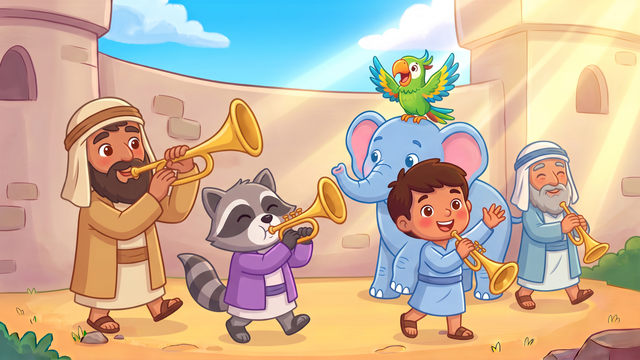
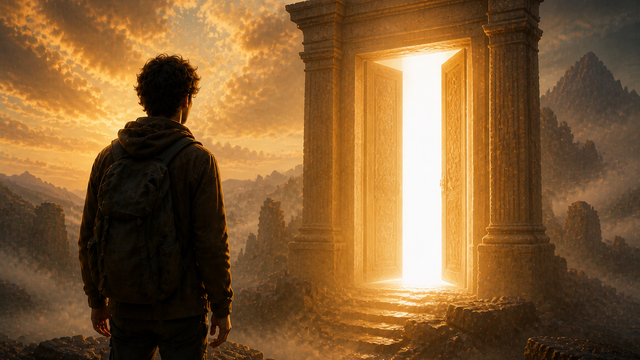
Finished videos from the community gallery, each with its full recipe (style, engine, voice, lyrics or script) that you can remix with your own words.



Frequently asked questions
Is there a free AI Bible video generator?
TubeTube gives you 1,000 credits at signup, enough to make and download your first narrated Bible video. That download carries a small tubetube.io mark, because clean, watermark-free mp4s come with a paid plan. Your master is stored in full quality without the mark either way, so subscribing later unlocks clean downloads on everything you've already made. Those signup credits stay valid for 7 days. After that it runs on credits (1 credit is about $0.011) with plans at $11, $49, $129 and $399 per month, 10% cheaper billed annually. There's no unlimited free plan anywhere in this space, because video generation compute is what you're actually paying for.
Can AI Bible videos be monetized on YouTube?
Yes, when they're original. A script you wrote, narration you chose and visuals generated for that specific video count as transformative content. Bible audiences skew adult, so RPM sits in the general range of roughly $3 to $8 rather than the $0.10 to $3 of kids content. Do disclose AI-generated material where YouTube asks, and avoid uploading near-identical retellings in bulk, which risks the inauthentic-content policy.
What is the best AI voice for Bible narration?
Deep, slow and warm. Think documentary narrator, not radio host. TubeTube lets you filter the ElevenLabs voice library by language, gender, age and accent, and preview each one before you commit. A lower register with an unhurried pace is what makes a retelling of Exodus feel weighty instead of rushed.
How do I keep the same Moses across every scene?
With character consistency. TubeTube feeds your reference images into every scene it generates, so Moses keeps the same face and robe from the burning bush to the Red Sea. You also lock one visual style for the whole video, which stops the world around him from shifting between scenes.
Can I dub a Bible video into Spanish or Portuguese?
Yes. TubeTube dubs a finished video into 24 languages, up to five per run, and Spanish and Portuguese are exactly where Bible channels multiply their reach, since Latin America is one of the largest Christian audiences on YouTube. You make the story once and publish it across several channels.
How long should an AI Bible video be?
5 to 10 minutes is the sweet spot for a single story, long enough to build real watch time from an audience that actually listens to the end. TubeTube builds long-form videos, not just 8-second clips, and the edit stays synced to the narration however long the script runs.